Quark I - Quark IV

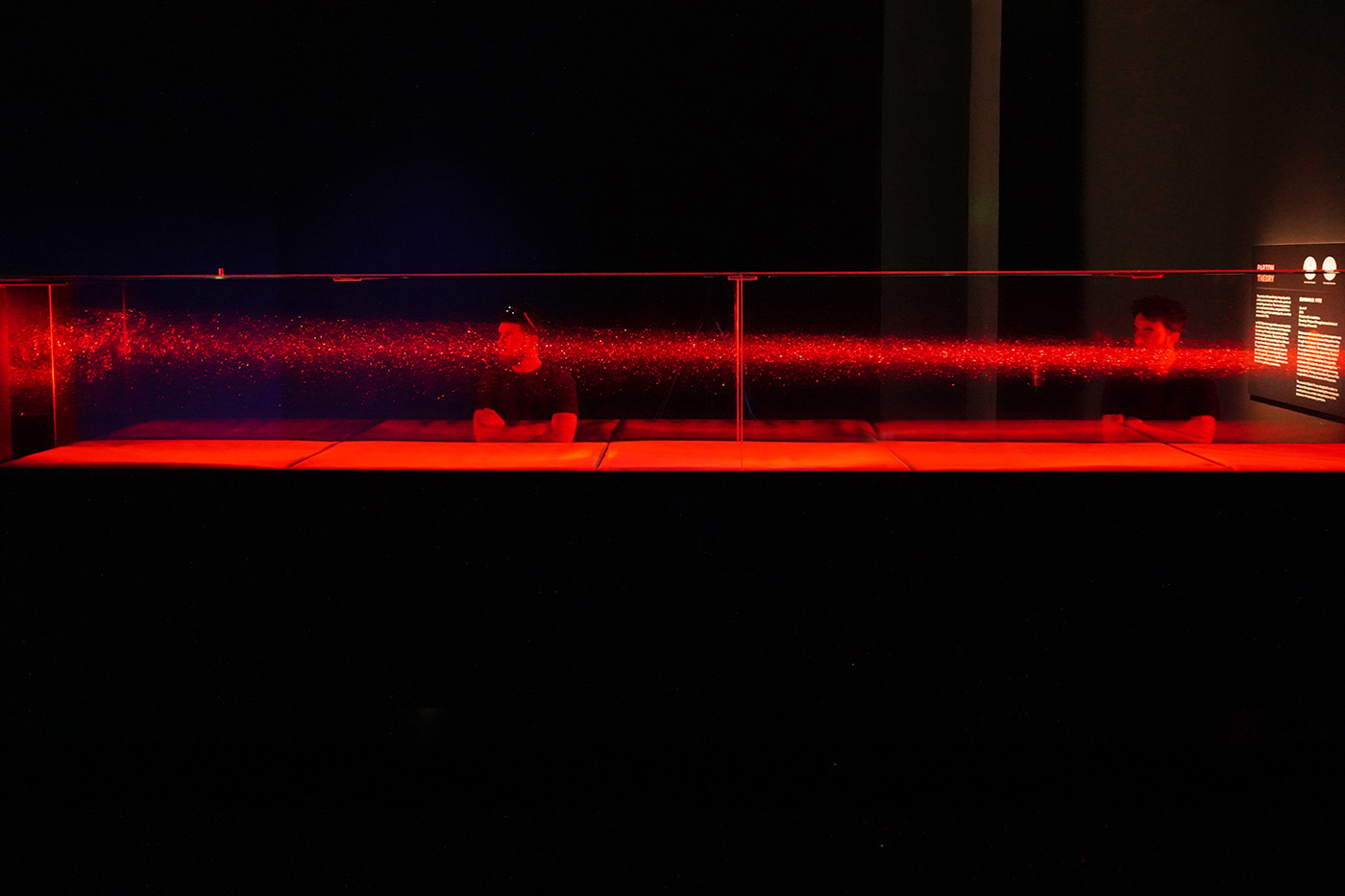


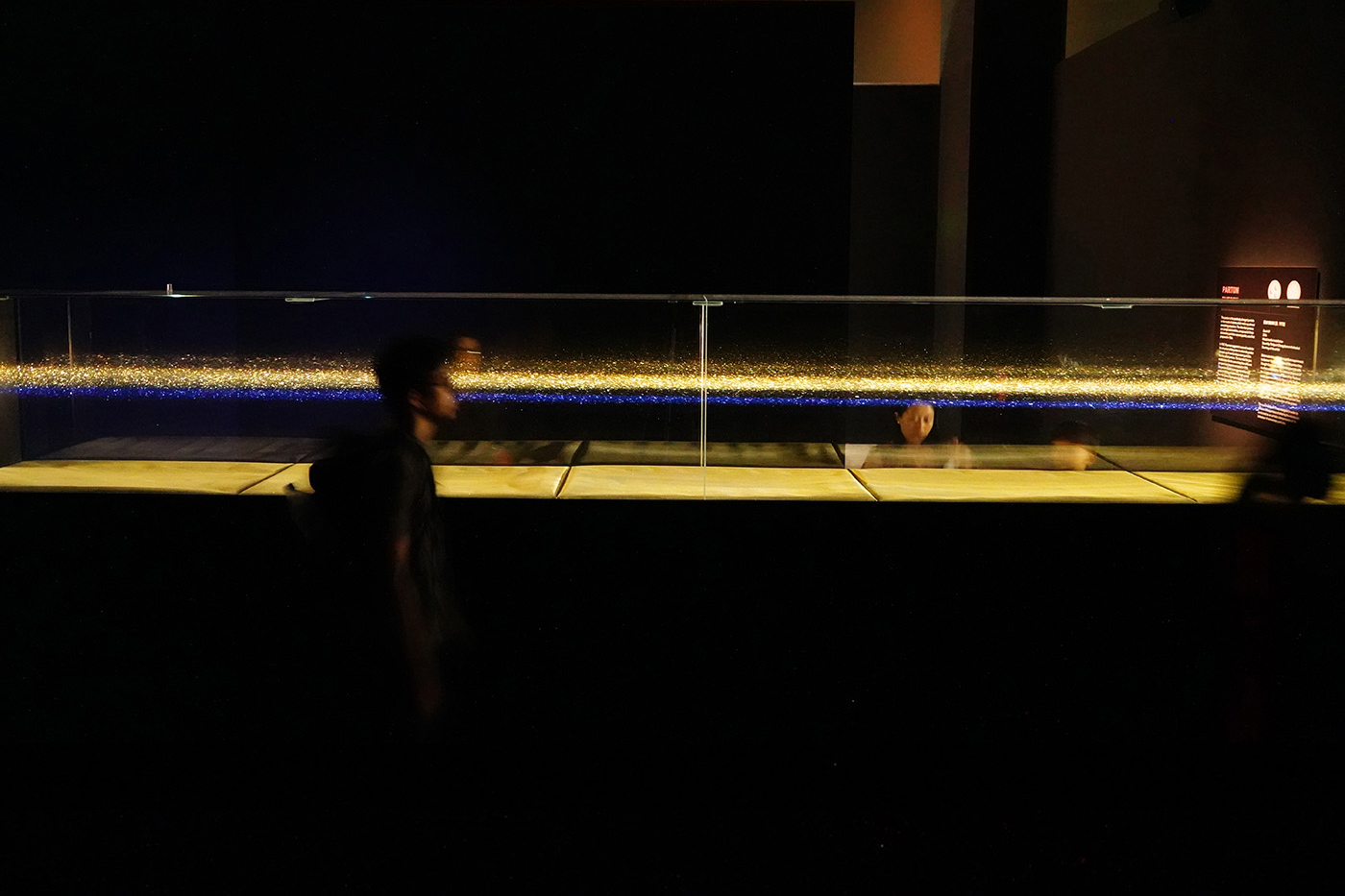





Quark I / IV ( Air / Beam Spot)
Seeing dust floating in the air has fascinated the installation artist for long. Out of Eiji Sumi’s particle physics-based exploration has grown an open-ended installation series named after a very small part of matter – quark. QUARK I, II, III, and IV, may be interpreted as an ode to the particle that is both energy and matter. Suspended in air and water, the light reflecting particles create both controlled and unpredictable patterns of movement. This suggests the air and water sculptured figures illustrating artistically that waves act like particles, and particles act like waves.
Photons (Sabatomic Particle, Gauge Bosons) is waves as all the matter or particles in the quantum mechanics or field contain waves as basic element. The artist exploits this known physical property of light in the production of the QUARK series that uses the idiosyncratic properties of reflective powder commonly used in ink, paint, coating, and fabrics for safety gear to provide higher security in the dark. For visualising what we usually do not see in our sight, the artist used a reflective powder and exploited the characteristics of fine pigments and the principles of light and energy control by magnetic field and electricity and matters.
The air and water flow charged by energy creates aero-dynamics sculpture that change form and shape and explosive movement overtime. Repeatability is inbuilt in the systems that experiment with light refraction to visualise the enigma of current flow and imaginary Quantum mechanics collision. Quark IV speak insight of quantum mechanics. Artist was inspired by all phenomena involving electrically charged particles interacting by means of exchange of photons and represents the quantum counterpart of classical electromagnetism giving a complete account of matter and light interaction as lighting is artist’s media interest. Shape of the work was inspired by particle accelerator an apparatus for accelerating subatomic particles to high velocities by means of electric or electromagnetic fields. The accelerated particles are generally made to collide with other particles, Artist says imagination taking us through particle collision when the stream of particle spark and explode how light and matter interact.
Another element of Quark is the flavour which is colors of RED, GREEN, and Blue, and Anti Red, Anti Green, and Anti blue. Actual color is not reflected in Quantum mechanics of quark and it is actually the term to configure the charge here, yet, in Sumi’s art work, these color element as well has influenced art work as inspiration of electronic charge of Quark and visual interpretation of the light and colours.
On the contrary, The Large Hadron Collider (LHC) ,all the magnets on the LHC are electromagnets. The main dipoles generate powerful 8.3 tesla magnetic fields – more than 100,000 times more powerful than the Earth’s magnetic field, When particles are bunched together, they are more likely to collide in greater numbers when they reach the LHC detectors with closer to light speed, Quark IV contain mutiple programmed electronics and create imaginary quantum chromodynamics collision with the material of everyday matter in our physical world with light particle photon. By doing this experiments artist try to visualise the world of quantum mechanics where we can’t see in our eyes.
Quark II ( Water / Mini Projecter ) , Quark III ( Water / Lasor )
In quantum mechanics and particle physics, spin is an intrinsic form of angular momentum carried by
elementary particles, composite particles (hadrons), and atomic nuclei, such as Quark, Leptons, and Gauge
Bosons. Spin is a bizarre physical quantity. It is analogous to the spin of a planet in that it gives a particle
angular momentum and a tiny magnetic field called a magnetic moment.
The water pockets that form in the light stream inside appear in every loop as they transform and create the
water sculptures in the vortex. Artificially created fluid dynamics, with a magnetic energy, it creates positive
and negative flow of repel and attract within turbulence system, these mesmerizing figures and pattern
appear in numerous and different configurations as if microscopic view of elementary particles, collide and
decay in Quantum Electrodynamics and macroscopic view of imaginary world of Black Holes in the Cosmic
world. This installation is seeing Blackhole as not only sucks in matter, swirls inward until it disappears but
with the representation of the energy at the expense of rotating and hurled outward the perpendicular jet
which might spread and stir the matter in the large part of the universe.
Recently, the first image of a black hole was captured in 2019 by the Event Horizon Telescope (EHT) collaboration. And we are finding more
about the mystery of Black Hole. Black Hole is believed to release the gas and stir the substances of the universe. it ricochets off the event
horizon and is hurled outward the bright jets of material traveling at near-relativistic speeds are created. {1} Although the black hole remains
unseen, these powerful jets can be viewed from great distances. As Dark matter is the mysterious substance that makes up around 85% of the
total mass of the universe, with these finding of the powerful jets released from Black Hole, we might see Black Hole could have played
significant role releasing and stirring and spread the substances of the matter in universe, possibly matters related to dark matter although we
still don't have a concrete theory on where the phenomenon of the dark matter fits with existing physics.
[1} Tillman, Nola Taylor, Daisy Dobrijevic, and Ben Biggs. “Black Holes: Everything You Need to Know.” Space.com. Space, May 6, 2022. https://
www.space.com/15421-black-holes-facts-formation-discovery- sdcmp.html.
Copyright © 2021 Studio Eiji Sumi